

By 'Lolu Akinwunmi
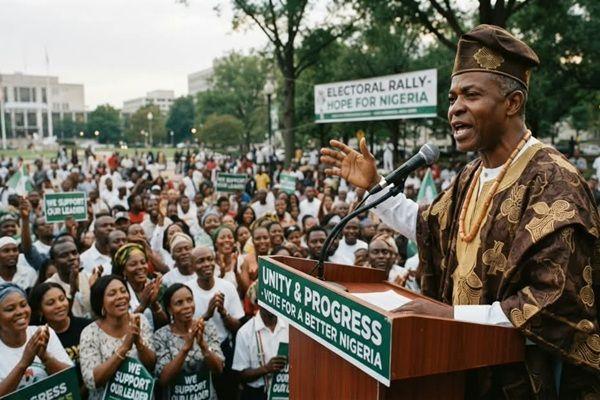
In this presentation, we move from listening to citizens to translating policy and achievement into citizen meaning. This particular presentation is very important to me because, over a long period, I have observed that governments do not sufficiently communicate the benefits of their achievements to the people; they simply throw around statistics! Governments and political candidates love numbers:
- Thousands of kilometres of roads.
- Billions invested.
- Millions of jobs promised.
- 500 new classrooms constructed.
- 17 Hospitals commissioned.
- 5 Agricultural programmes launched.
- GDP increased.
- Foreign investment attracted.
These may all be important. But the voter eventually asks a much simpler question:
What does this mean for me?
This may be one of the most important questions in political communication.
PEOPLE DON’T LIVE INSIDE STATISTICS
Statistics provide evidence. They establish scale and can demonstrate progress. But citizens experience government through life:
- A new road matters because a journey that once took three hours now takes one.
- Investment matters because factories open and people find work.
- Electricity reform matters because businesses spend less generating their own power.
- Healthcare expenditure matters because treatment becomes available and affordable.
- Education policy matters because children actually learn.
- Economic growth matters when people can feel some consequence of that growth in their opportunities and living conditions.
Political communication therefore needs to translate policy into human outcome.
REAGAN’S SIMPLE QUESTION
During the closing stages of the 1980 US presidential debate, Ronald Reagan asked voters:
“Are you better off than you were four years ago?”
The communication principle is striking. He converted a complicated argument about inflation, employment, taxation and economic management into personal experience. The voter did not need an economics degree to answer. The question effectively said:
Forget the abstraction for a moment. Examine your life.
That is citizen-centred communication.
FROM OUTPUT TO OUTCOME
Communication professionals advising governments and candidates should understand the distinction between output and outcome.
An output tells me what government did.
An outcome tells me what changed because government did it:
- “We constructed 500 kilometres of roads” is output.
- “Farmers can now move produce to markets faster and at lower cost” is outcome.
- “We built 200 primary healthcare centres” is output.
- “More families can now obtain treatment closer to home” is outcome.
- “We attracted $5 billion in investment” is output.
- “How many businesses, jobs and opportunities did that investment create?” is the citizen’s question. The output is still important.
- But the outcome gives the output meaning.
CLINTON: PUTTING PEOPLE FIRST
Bill Clinton’s 1992 campaign provides another useful historical example. The phrase “Putting People First” was attached to an economic programme covering investment, employment, healthcare and other issues. The communication significance lay partly in the framing. The programme was not presented simply as a collection of economic mechanisms. Its language attempted to connect economic policy to people. That principle remains valuable. Political communication should continually ask:
Where is the citizen in this story?
THE BUREAUCRATIC GOVERNMENT LANGUAGE
Governments often communicate in language created for bureaucracies rather than citizens. We hear expressions such as:
- “sectoral intervention,”
- “fiscal consolidation,”
- “infrastructure development framework,”
- “multilateral financing arrangement,”
- “macroeconomic stabilisation.”
These may be perfectly legitimate technical descriptions. But they are not necessarily communication, and oftentimes mean little to the citizen. The communication professional’s job is not to distort policy or oversimplify serious issues. It is to translate without trivialising:
- If inflation falls, explain what that could eventually mean for household purchasing power.
- If a railway is completed, show whose journey changes.
- If agricultural productivity improves, connect it to food availability, farmer income or prices where the evidence supports that connection.
- Bring policy down from the conference room and place it on the kitchen table.
DO NOT PERSONALIZE COMMUNICATION
Political communication can also become excessively candidate-centred, based on ego
- I built.
- I created.
- I attracted.
- My government achieved.
While leadership deserves legitimate credit for achievements, communication becomes more powerful when the story moves from:
- “Look what I have done.”, to:
- “Look what has changed for you.”
The first seeks applause. The second establishes relevance. And relevance is central to persuasion.
TRANSLATING POLICIES TO HUMAN STORIES
This is where storytelling becomes useful. Suppose a policy has enabled thousands of small businesses to obtain affordable credit. The number matters. But somewhere among those thousands is a woman who expanded her shop, employed three additional people and increased her family’s income. It is more useful to tell the story truthfully. Now the policy has a human face. Strong political communication combines:
DATA + HUMAN EXPERIENCE.
- The data provides scale.
- The story provides meaning.
- Neither should replace the other.
PLEASE, NO MANUFACTURED STORIES; EXAGGERATION; TESTIMONIES etc.
There is an important ethical warning. Citizen-centred communication must not become emotional manipulation. Do not manufacture beneficiaries. Do not stage testimonials and present them as spontaneous. Do not exaggerate outcomes. Do not select one exceptional success and imply that everybody has had the same experience. Political communication ultimately depends upon credibility. A moving story that later proves misleading can damage the very brand it was designed to strengthen.
THE “SO WHAT?” TEST
Before releasing any major political communication, campaign teams might apply a simple test. by always noting that citizens may ask the question: “SO WHAT?” Your communication says:
- We built the road; So what?
- We attracted the investment; So what?
- We changed the law; So what?
- We launched the programme; So what?
I wiah the people in government and political parties responsible for public communication would know that Citizens do not experience governance primarily through press releases, data, policy documents or campaign manifestos. They experience it through their lives. And strong political communication connects the two.
Don’t merely tell people what you have done or intend to do: Tell them why it matters to them, and the positive impact in their lives.
‘Lolu Akinwunmi
Publisher, The MarCom Strategic Series (MSS)
lakinwunmi@primagarnetafrica.com

Administrator contributes reporting and analysis on advertising for Brandish.
Keep Reading

‘Lolu Akinwunmi writes: CONSISTENCY: ONE CAMPAIGN. ONE MESSAGE. ONE VOICE.

Are Nigerian service providers poised for Extra Mile following Customer Service Week?
Sterling Bank collaborates with Cascador in $200 million fund to derisk startup business loans

Buy now, pay later: is Nigeria ready for a new culture of consumer credit?

UBA secures landmark court victory in a N156Bn debt recovery case against the Vaswani Brothers, owners of the Stallion Group

No comments yet — be the first to comment.