


Nigerian billionaire Aliko Dangote has acquired a 25% stake in Kenya Pipeline Company (KPC), strengthening his ambition to build an integrated petroleum refining, storage and distribution network across Africa.
As published by Global Financial Digest, Africa’s richest man, Aliko Dangote, has expanded his energy investments into East Africa after announcing on Wednesday that his company had acquired a 25% stake in Kenya Pipeline Company, the state-linked operator responsible for transporting petroleum products across Kenya.
Dangote disclosed the transaction at the Financial Times Africa Summit in London, a day after Kenyan President William Ruto confirmed that private investors had acquired a 25% interest in the country’s pipeline network from public entities without identifying the buyers.
The Financial Times reported that the stake was acquired for about $335 million.
It also reported plans by Dangote to invest a further $1.5 billion in expanding the pipeline network, although the precise timetable and structure of the proposed investment were not detailed in the available announcement.
The acquisition places Dangote in a stronger position to connect refining capacity with the infrastructure needed to move fuel to consumers and industrial markets.
It also complements his planned 700,000-barrel-per-day refinery at Lamu, Kenya, where construction was formally launched in September.
The Kenya Pipeline Company investment is part of a wider strategy to establish a more integrated energy supply chain in Africa, where many countries continue to depend on imported refined petroleum products despite the continent’s crude oil resources.
KPC operates an extensive network of pipelines and storage facilities that transports petroleum products from the coastal port of Mombasa towards Nairobi and other inland markets.
Its infrastructure makes it an important component of Kenya’s fuel distribution system and a potential route into neighbouring markets.
For Dangote, ownership of a significant minority stake offers exposure to an established distribution network as he prepares to develop a large refinery in Lamu.
The combination could, over time, link refining, storage and transportation, although the extent to which the pipeline investment will directly serve the proposed refinery has not been publicly detailed.
The Lamu project is designed to process 700,000 barrels of crude oil daily, making it one of the largest planned refinery developments in the region.
The complex is also expected to include power generation and fertiliser and chemical manufacturing facilities, broadening its potential impact beyond fuel supply.
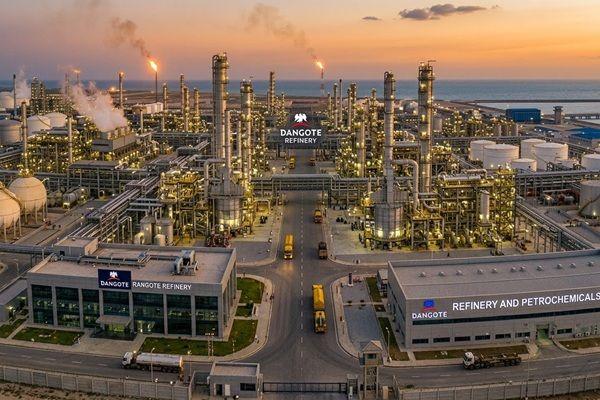
Dangote already operates a refinery near Lagos with a stated capacity of about 650,000 barrels per day.
The facility has become a major part of his industrial group, whose interests span cement, fertiliser, sugar and other sectors.
The Kenyan investment signals a move beyond refining into the infrastructure that determines how petroleum products reach end-users.
Dangote has also outlined plans for fuel storage projects in Namibia, Djibouti and Cameroon, according to the Financial Times, suggesting that his expansion strategy extends beyond a single East African market.
READ ALSO: Nigeria plans strategic fuel reserves, forward crude sales to cushion petrol price shock
The deal follows Kenya’s sale of a 65% stake in KPC through an initial public offering earlier this year, in one of the country’s most significant share sales in nearly two decades.
The IPO was priced at 9 Kenyan shillings per share and opened the pipeline company to local and international investors.
The Kenyan government subsequently received about 103.45 billion shillings from the transaction, with the proceeds earmarked for the National Infrastructure Fund and priority infrastructure projects.
The sale reflects the government’s effort to raise funds for development at a time of constrained public finances, while bringing private capital into established public assets.
Rather than relying exclusively on new borrowing or higher taxes, the administration has sought to mobilise investment through privatisation and capital-market transactions.
For investors, KPC offers exposure to critical energy infrastructure with an established role in Kenya’s domestic fuel supply.
For the government, the transaction provides funds for development while shifting part of the ownership and investment burden to private shareholders.
The scale of Dangote’s acquisition and the reported expansion plans also highlight the growing importance of cross-border investment in African energy infrastructure.
However, the commercial returns will depend on the pipeline company’s performance, future investment requirements, regulatory conditions and the pace of growth in regional fuel demand.
Dangote’s expansion comes as African governments seek to strengthen domestic processing and distribution capacity, reduce exposure to international supply disruptions and capture more value from the continent’s energy resources.
The proposed Lamu refinery is central to that ambition. If completed and operated at its planned scale, it could supply petroleum products to Kenya and wider regional markets, potentially reducing dependence on imported finished fuels.
The accompanying pipeline and storage investments could help address the logistical challenge of moving those products efficiently.
Still, a refinery’s announced capacity is not the same as actual production.
The Lamu project must progress through construction, commissioning and commercial operations before its potential contribution to regional supply can be assessed.
Its final impact will also depend on financing, crude supply, market demand and competition from existing suppliers.
Dangote’s latest move therefore represents more than a minority investment in a pipeline operator.
It is a strategic bet that Africa’s energy business will increasingly depend not only on refining crude oil, but also on owning and developing the infrastructure that stores, transports and distributes the resulting products.
For Kenya, the transaction brings a major African industrialist into a strategic infrastructure asset as the government pursues private-sector financing for development.
For Dangote, it adds a key distribution platform to a growing regional energy portfolio.

Administrator contributes reporting and analysis on energy for Brandish.
Keep Reading

Nigeria and India target $15 billion trade revival as Modi seeks renewed crude oil purchases

Aliko Dangote plans Africa fuel network across East, Central and Southern Africa in $50 billion expansion
Dangote’s ₦5,250 investment opportunity: the billions behind small investors’ money

Africa’s recycling industry opens new business opportunities for entrepreneurs and investors

Lolu Akinwunmi writes: Don’t let your opponents define and control your story

No comments yet — be the first to comment.