

By Maryanne Opene
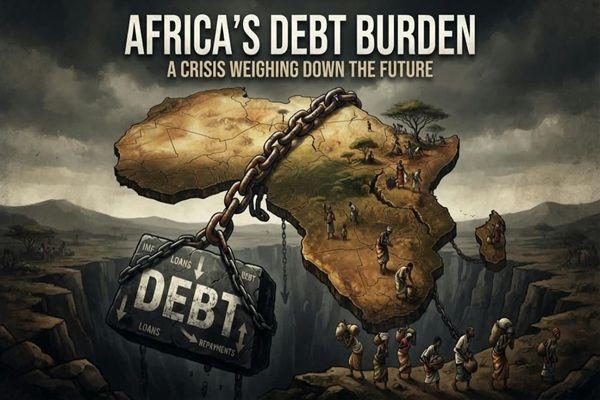
President Bola Ahmed Tinubu’s reported push for an African credit rating agency has opened a fresh conversation about how the continent is judged by international financial institutions and how much African countries pay to borrow.
But behind the debate over credit ratings lies an even bigger question: how much debt can African countries continue to take on before borrowing itself becomes part of the problem?
For Nigeria, that question is particularly important.
The country has continued to borrow to finance infrastructure, support government spending and meet other financial obligations. Successive administrations have defended borrowing as necessary for development, arguing that a country cannot build the infrastructure it needs if it refuses to invest because of concerns about debt.
That argument has some merit.
Borrowing is not necessarily a bad thing. Countries borrow all over the world to finance projects that they cannot immediately fund from their revenues.
The real issue is what the borrowed money is used for, how much is being borrowed, the cost of the borrowing and whether the country can comfortably repay it.
This is where Nigeria’s debt conversation becomes more complicated.
A government can borrow billions of naira and still claim that the money is being invested in roads, railways, power, healthcare, education and other areas that are expected to generate economic benefits.
But if the country's revenues remain weak while debt obligations continue rising, the government may eventually find itself borrowing again simply to meet previous commitments.
That creates a dangerous cycle.
Instead of debt helping the economy grow, new borrowing begins to support the cost of old borrowing.
This is why the discussion around Africa’s credit ratings should not only focus on whether international agencies are being fair to African countries.
It should also force African governments to examine why they need to borrow so heavily in the first place.
Nigeria, for example, has enormous economic potential.
It has a large population, significant natural resources, a huge consumer market and a private sector capable of supporting stronger economic growth.
Yet the government continues to face a major revenue problem.
When revenue is insufficient to meet expenditure, borrowing becomes an attractive option.
The danger is that borrowing can begin to look like an easy solution to a structural problem.
A government needs money today, so it borrows.
Another government comes into office and discovers that there is still a funding gap, so it borrows again.
Eventually, the question changes from whether the country needs the money to whether the country can afford to keep taking it.
This is where debt sustainability becomes critical.
The issue is not simply the size of Nigeria's debt.
It is the relationship between debt, government revenue, economic growth and the cost of servicing those obligations.
A country with a large economy and strong revenues may be able to carry a debt that would overwhelm a smaller economy.
Likewise, a country can have what appears to be a manageable debt burden but still struggle if a large portion of its revenue goes towards servicing that debt.
For ordinary Nigerians, the consequences are not abstract.
Money committed to debt servicing is money that cannot be spent elsewhere.
When government finances become increasingly constrained by debt obligations, funding for infrastructure, education, healthcare and other public services can come under pressure.
That is why the question Nigerians should be asking is not simply, “How much has Nigeria borrowed?”
The more important question is, “What are Nigerians getting in return for the money being borrowed?”
If borrowed funds are being invested in projects that expand economic activity, create jobs, increase productivity and eventually generate more revenue, borrowing can become a tool for development.
But if loans are repeatedly used to cover recurrent expenses without creating new sources of income, the country risks leaving future generations with the bill for today's spending.
This also raises questions about the quality of public projects.
Borrowing money for a badly executed project does not suddenly become good borrowing because the project carries the label of infrastructure.
The country still has to repay the loan, whether the project delivers value or not.
This is why greater transparency around government borrowing is necessary.
Citizens should know why a loan is being taken, how much it will cost, what the money will finance, when repayment begins and what economic benefit is expected from the investment.
The emergence of an African credit rating agency could help the continent challenge some of the assumptions built into international assessments.
It could provide African economies with a stronger platform to explain their economic realities and potentially present risks and opportunities from a deeper understanding of local conditions.
But a new rating agency cannot make an unsustainable debt sustainable.
It cannot increase government revenue simply by changing a country's rating.
And it cannot make investors ignore weak economic fundamentals.
Ultimately, confidence will still depend on whether governments can demonstrate that they are borrowing responsibly and using borrowed money effectively.
For Nigeria, this is perhaps the most important lesson from the current debate.
The country should not only be asking whether international financial institutions are rating it fairly.
It should also be asking whether it is borrowing fairly from the future.
There is nothing inherently wrong with borrowing.
The problem begins when borrowing becomes a substitute for building a stronger revenue base, controlling waste, improving productivity and creating an economy capable of paying its own way.
Africa deserves a financial system that understands its realities.
But African governments also owe their citizens financial discipline.
The goal should not simply be to make it easier or cheaper for Nigeria and other African countries to borrow.
· The bigger goal should be to build economies that do not constantly need to borrow just to keep moving.
That is the real conversation hiding behind the debate over Africa's credit ratings.

Administrator contributes reporting and analysis on money for Brandish.
Keep Reading

Nigeria receives billions from its diaspora, but how much becomes productive investment?

JPMorgan deposits N50bn with the Central Bank of Nigeria as American number one bank perfects move for its Nigerian license

Nigeria has Africa's richest man, so why is it still struggling to become a manufacturing powerhouse?

Kenya's mobile money success holds important lessons for Nigeria's fintech industry

Nigeria’s $1.19bn food import bill exposes the business cost of weak local production
No comments yet — be the first to comment.