

By Ugonnabo Ngwu
There is a growing realisation in informed quarters that Nigeria's technological future is dependent on the quality of the political and institutional leadership rather than technology itself. This is as political leaders and captains of the IT sector share responsibility for the country’s advancement in technology.
Nigeria's digital economy is bedeviled by weak interfaces between: the federal and state governments, one regulator and the other, policy announced and what gets implemented, the promise of a programme and the experience of netizens.
These contradictions aren’t because Nigerians lack the ingenuity, ambition, or capital. The ruling party is now rising to the challenge by setting up a digital economy policy engagement desk within its office this October to liaise with the private sector, National Assembly and the government.
National Chairman of the All Progressives Congress (APC), Nentawe Yilwatda disclosed this while addressing leading chief executives of telecoms and technology companies at the National Digital Economy CEO Dialogue convened by Knowhow Media International in partnership with the party’s national secretariat.
Nigerian ICT grows from sector to engine of the economy
The National Bureau of Statistics (NBS) reports that the Information and Communication sector contributed 11.74 percent of Nigeria's real GDP in the second quarter of 2026, up from 11.18 percent the year.
Telecommunications and information services alone accounted for 9.72 percent of real GDP and grew by 10.38 percent, more than twice the 4.43 percent growth of the overall economy. There has also been an increase in broadband subscriptions which rose to 124.42 million in July 2026, with internet penetration reaching 57.40 percent.
Yilwatda, a professor of digital systems engineering, therefore affirmed that “When a sector grows at more than double the pace of the national economy, it is no longer a sector. It is an engine.”
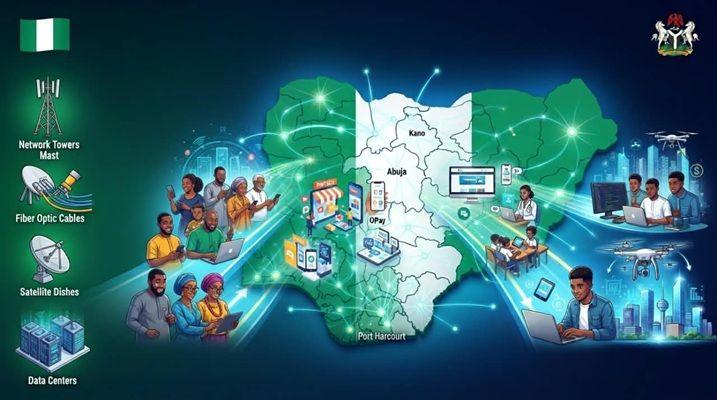
According to him, the most important infrastructure decision of the President Bola Tinubu administration in the digital space is Project BRIDGE which seeks to deploy 90,000 kilometres of open-access fibre across the country.
“Everything begins with infrastructure. There is no artificial intelligence without compute, no compute without data centres, no data centres without power and fibre, and no digital inclusion without affordable, reliable connectivity at the last mile,” he pointed out.
How digital transformation is assuming political consideration
The APC boss maintained that when a sector drives growth, determines inclusion, touches national security, and defines sovereignty like the ICT does, it becomes a political question in the true sense of that word. “A question about how we organise our common life. And political questions require political leadership.”
With Nigeria’s presidential election due to hold on January 16, 2027, the outcome of the polls will be a referendum on economic performance and the credibility of reforms embarked upon by the government of the day.
The ruling party wants to be judged squarely at the polls on the ledger of its impact on the digital economy as evidenced by its jobs, services, infrastructure, and its promise to young Nigerians.
Six tests to weigh political leadership’s commitment to digital economy
The current government is faced with the demands of vision, predictability, coordination, protection, capital mobilization, and building skills for Nigerians to become producers rather than mere consumers of advanced tech products.
Yilwatda turned these demands into test questions by which any group of persons seeking to assume or retain political authority over the country should be appraised. In terms of vision, he asked: Does leadership know where it is going, and can it say so in terms that an investor can price?
Per predictability, the question is whether the rules under which you invest today still hold in five years' time. In terms of coordination: do the federal government, the states, the local governments, and the regulators pull in the same direction, or do they tax, license, and obstruct you separately?
The fourth is protection, with the question bordering on whether the state would protect the infrastructure built by investors and the data they hold. In terms of capital, does policy help to mobilise patient, affordable, local, and international finance for long-horizon assets?
The last test is whether the political leadership is building the skills that will make Nigerians producers, not just consumers, of the digital age.
Yilwatda harped on the need for political leaders to provide investors with predictability, builders with protection, and citizens with access.
Apart from the establishment of a digital economy policy engagement desk in the APC secretariat, other commitments made by the party’s national chairman include the ensuring:
• Work with the APC National Assembly Caucus to prioritize and pass digital economy legislation, including the legal framework for e-governance and responsible AI.
• Engage with governors under the Progressive Governors Forum to harmonize right-of-way terms and protect telecommunications assets in their states.
• Ensure the digital economy is a clear and major pillar in the APC's agenda and program for 2027-2031, with measurable targets.
• Schedule an immediate online meeting with the desk officer, Dr. Peace Londet and representatives from the CEOs to establish timelines for actualising these commitments.

Administrator contributes reporting and analysis on telco for Brandish.
Keep Reading

Airtel Money’s revenue rises 25.1% to $830 million in maiden results
NSIA startup awards put focus on turning Nigerian innovation into scalable businesses

TotalEnergies Nigeria returns to N8.02 billion pre-tax profit, misses Q3 forecast

The beers are back; International Breweries’ nine-month pre-tax profit rises 22% to N90.44bn

3,000 delegates from 126 countries to gather in Nigeria for gobal Public Relations forum

No comments yet — be the first to comment.