

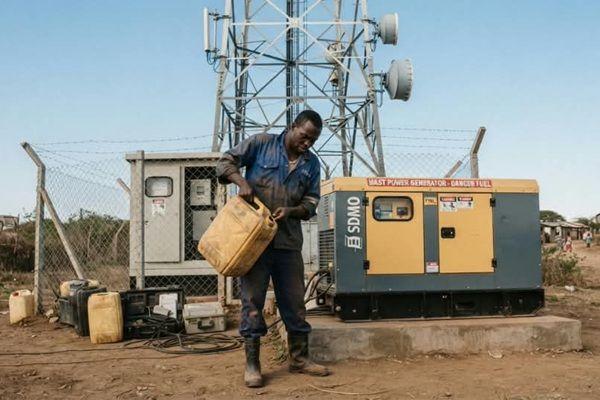
Nigeria’s telecommunications industry is facing mounting financial pressure as rising diesel prices increase the cost of keeping mobile networks operational, raising concerns about profitability, infrastructure investment and the quality of services available to millions of subscribers.
The challenge extends beyond the financial performance of telecommunications companies. In a country where businesses and households increasingly depend on mobile connectivity for banking, education, commerce and everyday communication, the cost of maintaining reliable networks has become an important economic concern.
The latest adjustment by Dangote Petroleum Refinery illustrates the uncertainty confronting businesses that depend on diesel. On October 10, 2026, the refinery reportedly increased its diesel gantry price from ₦1,700 to ₦1,800 per litre, reversing part of an earlier reduction from ₦1,780 to ₦1,700 per litre. Depot prices were also reported at approximately ₦1,905 per litre.
For telecommunications operators, such increases can quickly translate into additional operating expenses. Mobile networks rely on thousands of base stations, transmission facilities and technical installations that require a consistent electricity supply. Where power from the national grid is unreliable or unavailable, diesel-powered generators often become essential to keeping equipment operational.
Unlike many businesses, telecom operators cannot simply suspend operations when energy costs rise. Their networks must function around the clock, supporting telephone calls, internet access, electronic payments and other services that have become part of everyday life.
Every additional expense associated with powering these facilities therefore affects the financial calculations behind network maintenance, expansion and service delivery.
The scale of diesel consumption makes the situation particularly significant. Figures attributed to the Africa Finance Corporation’s State of Africa’s Infrastructure Report 2025 indicate that Nigerian telecommunications operators consume more than 40 million litres of diesel monthly and spend over $350 million annually on the fuel.
At this level of consumption, even a relatively small price increase can create substantial additional costs. The financial burden is particularly challenging for operators maintaining extensive networks across urban centres, smaller towns and remote communities where access to reliable grid electricity remains limited.
The pressure also comes at a time when demand for telecommunications services continues to grow. More Nigerians rely on mobile internet for work, education, entertainment and commercial activities, while businesses increasingly require dependable connectivity to manage transactions and reach customers.
Meeting that demand requires continued investment in network capacity, equipment upgrades and wider coverage. However, when a growing share of available resources goes towards fuel, operators may face difficult decisions about how to balance immediate operational needs with long-term development plans.
MTN Nigeria has previously highlighted the potential financial consequences of rising diesel prices. The company reportedly estimated that diesel averaging around ₦2,000 per litre during the second half of 2026 could have a financial impact of between ₦120 billion and ₦140 billion on its full-year performance.
That estimate represents a projected impact under a particular pricing scenario rather than a confirmed final loss. Nevertheless, it illustrates the extent to which energy costs can influence the financial outlook of a telecommunications business.
For investors, the concern is whether sustained increases in operating expenses could weaken profitability or limit the resources available for future expansion. Telecommunications infrastructure requires significant capital investment, and uncertainty over recurring expenses can influence decisions about where and when new facilities are built.
The implications for subscribers are less straightforward. Higher diesel prices do not automatically mean that call rates or data tariffs will increase. Operators must consider competition, customer affordability and applicable regulatory requirements before making pricing decisions.
However, prolonged increases in operating costs could make it more expensive to maintain existing infrastructure and expand services into areas where network operations are already challenging.
This matters to small businesses that depend on mobile connectivity to receive payments, communicate with customers and promote their products. Traders, online vendors and service providers increasingly rely on digital platforms to manage daily activities and remain competitive.
When network services become unreliable, the consequences can include delayed transactions, interrupted business operations and lost sales. Students, remote workers and households that depend on internet access may also experience disruptions that affect their routines.
Nigeria’s digital economy therefore depends not only on telecommunications investment but also on the availability of affordable and reliable energy to support the infrastructure behind it.
The country's electricity challenges remain central to the problem. Where grid supply is inconsistent, operators must maintain generators, purchase fuel and arrange deliveries to facilities spread across different locations. They also incur expenses associated with generator servicing, repairs, security and equipment replacement.
These costs can be particularly burdensome at remote sites where fuel transportation is difficult and alternative electricity sources are limited.
The volatility of petroleum markets adds another layer of uncertainty. International oil prices, geopolitical tensions and supply disruptions can influence domestic fuel costs, even in countries with local refining capacity. Domestic refining may strengthen supply options, but it does not necessarily insulate businesses from price fluctuations.
Telecommunications companies are consequently exploring ways to reduce their dependence on diesel. Solar power, battery storage, gas-powered systems and hybrid energy installations offer possible alternatives, depending on the location and power requirements of individual sites.
A successful transition could reduce fuel consumption and make operating costs more predictable. It could also help operators manage the environmental effects associated with extensive generator use.
However, implementing alternative energy systems across thousands of sites requires considerable initial investment, technical expertise and long-term maintenance. Solar installations, for example, need sufficient battery capacity or backup power to keep equipment running during periods of limited sunlight and high demand.
For operators managing large networks, replacing diesel generators cannot happen everywhere at once. The transition will require careful planning, substantial funding and solutions suited to different operating environments.
Improving the reliability of electricity supplied through the national grid would also help address the problem. More dependable power could reduce generator usage, lower operating expenses and free up resources for network expansion and technological improvements.
This requires cooperation among government agencies, electricity providers, telecommunications operators and regulators. While telecom companies must pursue greater efficiency, they cannot independently resolve the wider infrastructure problems that make diesel generators necessary.
Regulators also face the challenge of protecting consumers while recognising the financial pressures confronting service providers. Operators must continue meeting applicable service standards, communicating clearly about disruptions and making responsible investment decisions.
Subscribers, meanwhile, will expect dependable connectivity rather than a situation in which operating expenses rise while network complaints persist.
The latest diesel price increase has exposed a structural weakness in Nigeria’s digital development: an industry expected to deliver increasingly sophisticated services still depends heavily on expensive backup power to maintain basic connectivity.
As demand for mobile data, digital banking and online commerce grows, energy costs will become an increasingly important consideration in the industry's investment decisions.
Reducing that vulnerability will require more than waiting for diesel prices to fall. Greater energy efficiency, alternative power sources and improvements in electricity supply could help operators withstand future price shocks.
Until those changes become widespread, diesel price volatility will remain a significant risk to Nigeria’s telecommunications industry, with consequences for business investment, network reliability and the millions of Nigerians who depend on digital connectivity every day.

Administrator contributes reporting and analysis on telco for Brandish.
Keep Reading

Airtel Money’s revenue rises 25.1% to $830 million in maiden results

NSIA startup awards put focus on turning Nigerian innovation into scalable businesses

TotalEnergies Nigeria returns to N8.02 billion pre-tax profit, misses Q3 forecast

The beers are back; International Breweries’ nine-month pre-tax profit rises 22% to N90.44bn

3,000 delegates from 126 countries to gather in Nigeria for gobal Public Relations forum

No comments yet — be the first to comment.