

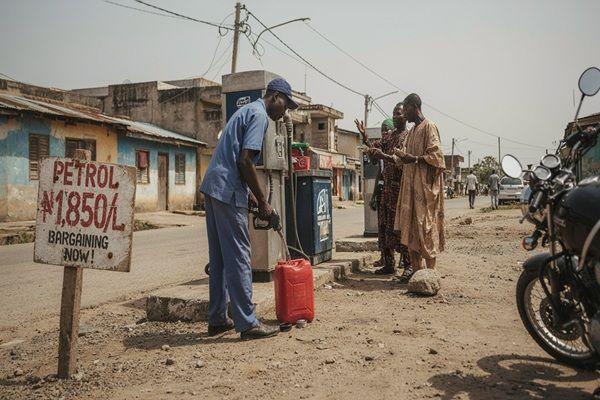
Petrol prices have risen sharply across Abuja, Lagos and Ibadan, with some filling stations now selling Premium Motor Spirit (PMS) for as much as N1,450 per litre, after a fresh increase in wholesale prices coincided with another surge in international crude prices.
The latest adjustment is already feeding through the downstream market, raising concerns about another round of pressure on transport costs, logistics and household spending if crude prices remain elevated.
Checks across major cities showed significant price movements over the weekend.
In Abuja, AY Shafa raised its pump price from N1,350 to N1,395 per litre, while Optima increased its price from N1,360 to N1,450. Empire filling station in Gwarinpa moved from N1,370 to N1,450, while Mobil in Kubwa raised its price from N1,350 to N1,400.
The increases were similarly pronounced in Lagos.
Conoil at Ikorodu Garage raised its price from N1,300 to N1,400 per litre, while an NNPC retail outlet at Berger moved from N1,299 to N1,380. Bovas at Berger increased its pump price from N1,280 to N1,400.
MRS in Okota moved from N1,310 to N1,395, while TotalEnergies raised its price from N1,325 to N1,385. AP at Ogba also adjusted its pump price upwards, from N1,295 to N1,380.
In Ibadan, Ocean Breeze filling station on Old Ife Road was selling petrol at N1,370 per litre on Sunday, compared with N1,300 a day earlier.
The latest movements, found petrol prices reaching N1,450 in parts of Abuja and N1,400 in Lagos.
The latest pump-price increases followed another adjustment by the Dangote Petroleum Refinery, which raised its petrol gantry price from N1,265 to N1,350 per litre, effective September 12.
The N85 increase represents a 6.7 per cent adjustment and is the refinery’s fourth upward review since August 21. Its gantry price has consequently risen by N185, or about 15.9 per cent, in just 22 days.
The successive adjustments illustrate how quickly changes in international crude prices are now being transmitted into Nigeria’s deregulated downstream petroleum market.
Unlike the period when government intervention largely determined pump prices, marketers now have to respond to changes in crude acquisition costs, foreign exchange, freight, insurance and other replacement costs.
That means a sustained rise in global crude prices can translate into higher wholesale and retail petrol prices relatively quickly.
The latest increase comes as the international oil market faces one of its sharpest supply-risk episodes in months.
Brent crude had already settled at $104.61 per barrel on Friday, while US West Texas Intermediate stood at about $100.05, with both benchmarks recording weekly gains of more than 8 per cent.
The market moved higher again at the start of Monday trading after fresh attacks in Saudi Arabia and the Strait of Hormuz.
Brent rose by $3.62 to $108.23 per barrel, while WTI gained $3.15 to $103.20.
The Strait of Hormuz remains one of the world’s most important energy chokepoints, while attacks on shipping and energy infrastructure have increased the risk premium attached to crude.
Saudi Arabia has also shut its East-West pipeline as a precaution after an attack, raising concerns about the country’s ability to move crude through an alternative route that bypasses Hormuz.
The combination of disruptions around Hormuz, attacks involving Saudi energy infrastructure and uncertainty over the duration of the conflict has left traders pricing in a higher probability of prolonged supply constraints.
That matters for Nigeria even though the country is a major crude producer.
Higher crude prices are not necessarily bad news for Nigeria’s public finances.
As an oil exporter, the country can earn more foreign exchange and government revenue when international oil prices rise, provided production remains stable and the additional earnings are effectively captured.
But the benefit becomes more complicated once Nigeria’s position as a net importer of some refined petroleum products and its exposure to international product pricing are considered.
For motorists and businesses, the immediate transmission is through petrol prices. Higher PMS costs raise the operating expenses of transporters, manufacturers, distributors, farmers and other businesses that rely heavily on road transportation.
That can quickly feed into food and consumer prices.
The latest increase therefore comes at a delicate point for the Nigerian economy, where headline inflation has moderated considerably from its earlier highs but households and businesses remain highly sensitive to fuel and transport costs.
The development also demonstrates why the expansion of domestic refining capacity, particularly the Dangote refinery, has not insulated Nigeria completely from international oil-price movements.
Domestic refining reduces dependence on imported finished products and can improve supply security, but the price of crude remains a fundamental component of the cost of producing petrol.
As long as refiners price crude and products against market conditions, a global oil shock can still work its way into domestic pump prices.
The bigger concern for the economy is what happens if crude remains above $100 for an extended period.
Higher fuel prices would increase transportation costs and could put renewed pressure on inflation. Logistics companies, manufacturers and retailers would face higher operating expenses, while consumers would have less disposable income after paying for transportation and other essentials.
For the Central Bank of Nigeria, a renewed fuel-price shock would complicate the inflation outlook even if other components of consumer prices continue to ease.
There is also a fiscal dimension. Nigeria stands to benefit from higher oil revenue, but that advantage depends on crude production, export volumes and the government’s ability to convert higher oil earnings into usable fiscal resources.
A prolonged global oil shock could therefore produce the unusual combination of higher government oil receipts alongside higher domestic living costs.
That is the dilemma now confronting policymakers as the Middle East conflict pushes energy prices higher.
For consumers, however, the impact is more immediate: filling stations across the country’s major commercial centres are already charging more for the same litre of petrol, with Abuja prices approaching N1,450.
If the international crude rally persists, the latest pump-price increases may prove to be the beginning of another period of downstream price adjustments rather than a one-off response to market volatility.
Bottom of Form

Administrator contributes reporting and analysis on energy for Brandish.
Keep Reading

Nigeria and India target $15 billion trade revival as Modi seeks renewed crude oil purchases

Aliko Dangote plans Africa fuel network across East, Central and Southern Africa in $50 billion expansion

Dangote acquires 25% stake in Kenya pipeline company, deepens East African energy push
Dangote’s ₦5,250 investment opportunity: the billions behind small investors’ money

Africa’s recycling industry opens new business opportunities for entrepreneurs and investors

No comments yet — be the first to comment.